



There is a particular kind of stillness that falls over a place during an eclipse. The birds stop singing. The temperature drops. The light thins into something unfamiliar and slightly unsettling, even when you know exactly what is causing it. For a moment, something that has never once failed to rise or shine looks small, dimmed, humbled.
It is precisely that moment — the shrinking of something we take entirely for granted — that our tradition asks us to respond to. Not with a caption for social media. Not with cardboard glasses and a countdown. But with prayer, humility, and, as we will see, with our hands open in charity.
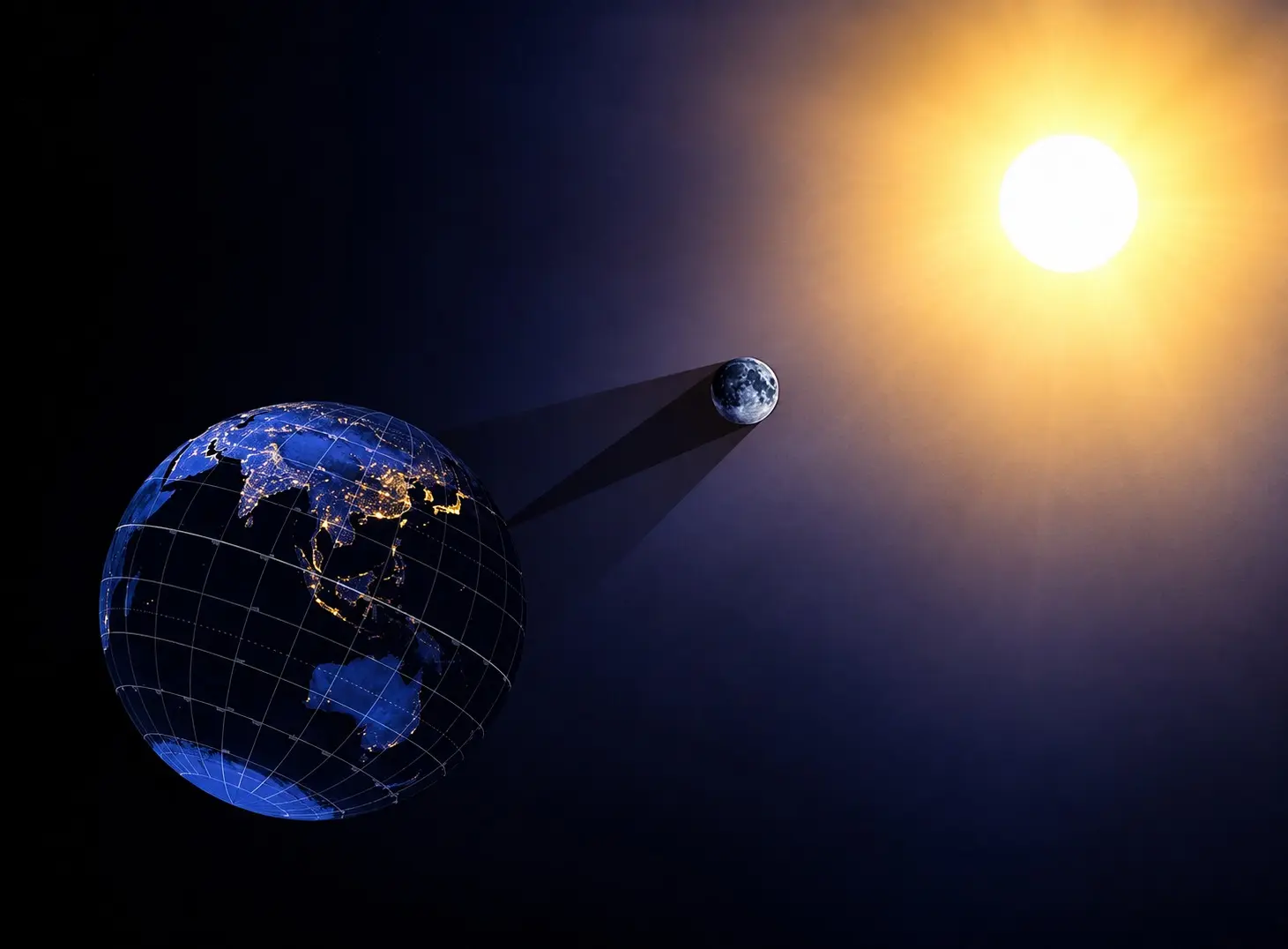
During a solar eclipse, the Moon casts two shadows on Earth. The first shadow is called the umbra (dark blue oval). The second shadow is called the penumbra (light blue oval). During a solar eclipse, observers within the Moon's umbra experience a total eclipse, while those within the penumbra see only a partial eclipse. Source: National Aeronautics and Space Administration (NASA), Why Do Eclipses Happen? NASA Science, accessed July 9, 2026. Credit: NASA's Scientific Visualization Studio
A Prayer Born From Awe, Not Fear of the Sky Itself
The prayer performed during a solar eclipse is called Salat al-Kusuf (صلاة الكسوف). A solar eclipse in Islam is far more than an extraordinary astronomical event in the sky. The sun and moon are among the signs of Allah, and when an eclipse occurs, Muslims are encouraged to turn back towards Allah through prayer, dua, remembrance, and seeking forgiveness.
During the lifetime of Prophet Muhammad ﷺ, a solar eclipse occurred on the day his infant son Ibrahim passed away. Some people in the community associated the darkness in the sky with his loss, but the Prophet ﷺ immediately corrected this belief. He explained that the sun and moon are signs of Allah and do not eclipse because of anyone's death or birth. He instructed Muslims that when they witness an eclipse, they should pray and supplicate to Allah until it passes.
When the Companions once saw the sun darken, the Prophet did not explain it away with reassurance. He rushed visibly anxious straight to the prayer, dragging his cloak behind him, and stayed in prayer until the sky returned to normal. That single instruction from him has carried down the centuries as Salat al-Kusuf. It teaches Muslims to respond to an eclipse not with superstition, but by remembering Allah and renewing their devotion.
رَبَّنَا آمَنَّا فَاغْفِرْ لَنَا وَارْحَمْنَا وَأَنتَ خَيْرُ الرَّاحِمِينَ
"Our Lord, we have believed, so forgive us and have mercy on us, and You are the best of the merciful."
— Surah Al-Mu'minoon
Observing the awe-inspiring phenomenon of a solar eclipse reminds believers of the immense power and order of Allah's creation.
How to Pray the Solar Eclipse Prayer (Salat al-Kusuf)
Salat al-Kusuf consists of two rak'ahs, but its method is distinct from ordinary daily prayers. Within each unit, there is more than one bowing, and recitation is stretched out as long as a person can manage. It can be prayed individually at home, but gathering in congregation brings shared humility and united supplication.
First Rak'ah
- Make the intention to perform Salat al-Kusuf.
- Begin the prayer with Allahu Akbar.
- Recite Surah Al-Fatihah followed by a long recitation from the Qur'an.
- Perform a long ruku (bowing).
- Rise from ruku and say: Sami'Allahu liman hamidah, Rabbana wa lakal-hamd.
- While remaining standing, recite Surah Al-Fatihah again, followed by another recitation that is slightly shorter than the first.
- Perform a second ruku, shorter than the first.
- Rise from ruku.
- Perform two sujood (prostrations) as usual.
Second Rak'ah
- Stand for the second rak'ah and repeat the same pattern: Recite Al-Fatihah and Qur'an.
- Perform ruku.
- Stand again and recite Al-Fatihah and Qur'an.
- Perform a second ruku.
- Complete two sujood.
- Finish the prayer with tashahhud and salam.

Muslims gathering to offer Salat al-Kusuf in congregation, uniting in humility and seeking forgiveness during an eclipse.
What Dua and Dhikr Should You Read During a Solar Eclipse?
There is no single mandatory formula restricted specifically for a solar eclipse. Instead, the Sunnah encourages Muslims to spend the entire duration of the eclipse remembering Allah, asking Him for forgiveness, and supplicating sincerely.
You can repeatedly seek forgiveness by saying:
أَسْتَغْفِرُ اللهَ
"Astaghfirullah — I seek forgiveness from Allah."
Other essential forms of dhikr recommended during this time include:
- SubhanAllah: Glory be to Allah.
- Alhamdulillah: All praise belongs to Allah.
- Allahu Akbar: Allah is the Greatest.
- La ilaha illallah: There is no god worthy of worship except Allah.

Turning to Allah with sincere heart, hands raised in dua and repentance as the darkness passes over the land.
Why the Prophet Stood Up and Spoke Afterwards
What is easy to miss reading descriptions of that historical day is what happened after the prayer ended. The Prophet stood, praised Allah, and delivered an address reminding the people of the moment's spiritual magnitude. Bound up in that reminder was a very specific instruction: give in charity.
The narrations mention the Prophet calling the people, in the aftermath of the eclipse, to sadaqah alongside dhikr, seeking forgiveness, and glorifying Allah. When something reminds us sharply that we are not in control, turning outward through charity bridges faith with action.
When the sun eclipsed, the Prophet told his Companions to do five key things:
- Pray Salat al-Kusuf: Two rak'ahs with two bowings in each and long recitations.
- Make dhikr: Takbir, Tasbeeh, and Tahmeed.
- Make dua and seek forgiveness: Continue istighfar until the light fully returns.
- Give charity: Sadaqah is highlighted side-by-side with prayer in authentic hadiths.
- Do good: Engage in general righteous actions, from settling debts to repairing relationships.
What Not to Do During a Solar Eclipse in Islam
Islam explicitly liberates believers from superstitions, myths, and cultural folklore. During an eclipse, an eclipse should NOT be considered:
- A sign that a particular person will pass away or be born.
- A harbinger of bad luck or bad omens for pregnant women.
- A source of magical or supernatural powers.
- A reason to observe cultural superstitions unsupported by Islamic teachings.

Transforming moments of spiritual reflection into tangible aid by helping vulnerable families and communities in need.
From the Sky to the Ground: A Moment to Turn Back to Allah
The Sunnah gives us a response that doesn't end when the sky clears. A moment that humbles us should leave something lasting behind: extra dhikr on our tongues, a more mindful heart, and a hand open in giving.
Every pound given in genuine humility reaches someone living through their own literal or figurative darkness—a family in Gaza without a hot meal tonight, an orphan in Pakistan without care, or a community without clean drinking water. Through Aghosh UK's Sadaqah and emergency relief appeals, your response to Allah's signs becomes a direct lifeline for those in need.
Solar Eclipse Prayer FAQs
What is the solar eclipse prayer called in Islam?
The solar eclipse prayer is called Salat al-Kusuf (صلاة الكسوف).
How many rak'ahs are in the solar eclipse prayer?
Salat al-Kusuf consists of two rak'ahs. In the Prophetic method, each rak'ah contains two periods of standing, two recitations of Surah Al-Fatihah, and two ruku (bowings) before going into sujood.
Is there a special dua for a solar eclipse?
There is no single compulsory or restricted dua specifically for a solar eclipse. Muslims are encouraged to make sincere dua in their own words, remember Allah, and seek His forgiveness.
Can I say Astaghfirullah during a solar eclipse?
Yes. Seeking forgiveness (istighfar) is strongly recommended during an eclipse. You can say Astaghfirullah repeatedly and offer sincere repentance to Allah.
What should I pray during a solar eclipse?
Perform the two-rak'ah Salat al-Kusuf, and spend the remaining duration of the eclipse making dua, dhikr, and istighfar.
Can I pray the solar eclipse prayer at home?
Yes, Salat al-Kusuf may be performed individually at home, though joining a congregational prayer at a local mosque is highly encouraged where available.
What should you not do during a solar eclipse in Islam?
Avoid myths, bad omens, and superstitions. Islam explicitly clarifies that eclipses are divine signs of Allah and are not caused by the birth or death of any human being.
When should Salat al-Kusuf be prayed?
The eclipse prayer is performed while the eclipse is actively taking place. The Prophet ﷺ instructed believers to pray and make dua until the sky completely clears.